The article analyses the dynamics of multilingualism in Senegal in a postcolonial context, with particular emphasis on the teaching of Slavic languages, especially Russian and Polish. It highlights that language policy in Senegal is shaped not only by local communicative needs but also by global power relations, diplomacy, and political strategies. The text underscores the growing role of the Russian language in Senegal’s educational system, supported by institutions and scholarships. Russian is taught at Cheikh Anta Diop University (UCAD) and in many secondary schools, where it is gaining popularity and is often associated with narratives of Russia’s strength and independence. Against this background, the text examines the place of Polish as a foreign language, which is taught as a supplementary subject with limited institutional support, maintained mainly by individual lecturers, informal networks, and the small Polish diaspora. Methodologically, the study is based on ethnographic fieldwork, participant observation, and interviews with students, teachers, and members of the diaspora in Dakar. The asymmetric position of Russian and Polish in Senegal’s educational system demonstrates that languages function as resources of power and as spaces for the development of various forms of politicality.
A. Pomieciński, The dynamics of multilingualism: teaching Slavic languages in multilingual Senegal, „Rocznik Instytutu Europy Środkowo-Wschodniej” 23 (2025), z. 1, s. 7–38, DOI: https://doi.org/10.36874/RIESW.2025.1.1
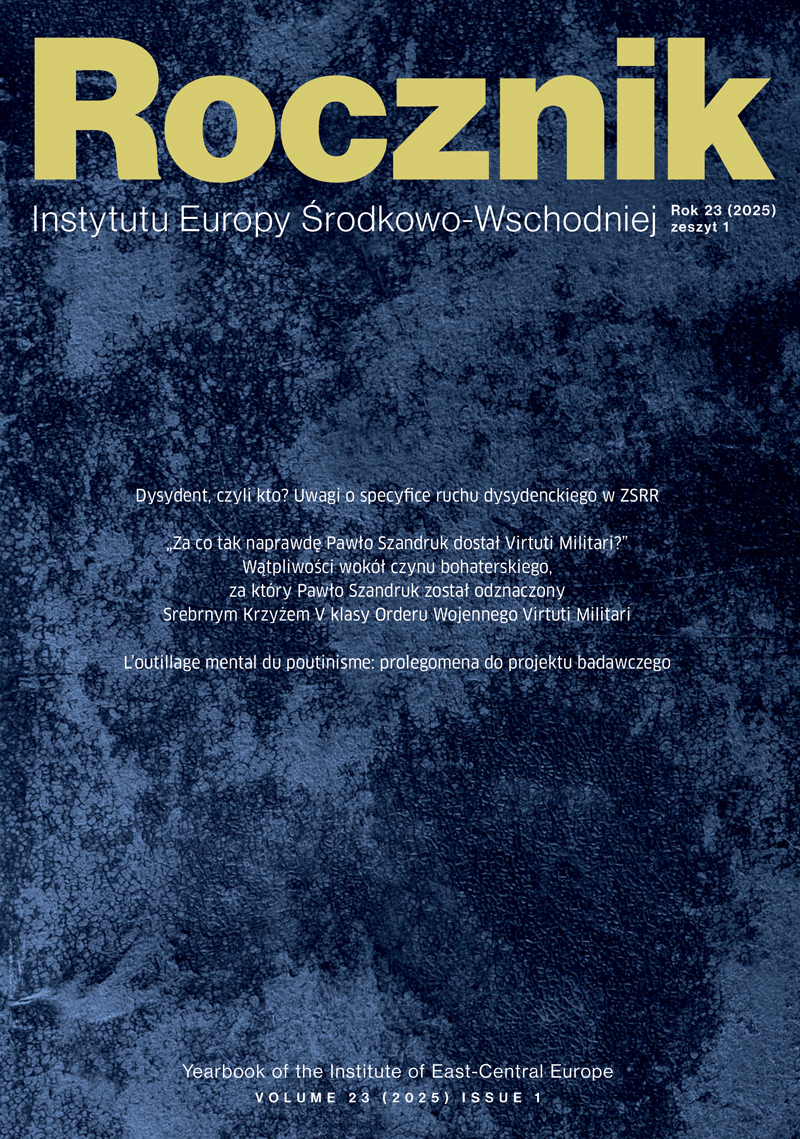
Pavlo Shandruk was undoubtedly a controversial figure. His activities in the final phase of the World War II continue to cause controversy, especially his takeover of the Ukrainian National Army in the spring of 1945. In September 1939, he fought as a contract officer in the Polish Army with the rank of certified lieutenant colonel, for which he was awarded Poland’s highest military order after the war. The aim of this article is to resolve the question of which specific act during the 1939 campaign earned Pavlo Shandruk the Silver Cross, 5th class, of the War Order of Virtuti Militari from the Polish President-in-exile. In addition, the article discusses the course of the officer’ service in September 1939, especially in the context of the so-called second battle of Tomaszów Lubelski, and clarifies inaccuracies associated with it.
P. Greszta, „Za co tak naprawdę Pawło Szandruk dostał Virtuti Militari?” Wątpliwości wokół czynu bohaterskiego, za który Pawło Szandruk został odznaczony Srebrnym Krzyżem V klasy Orderu Wojennego Virtuti Militari, „Rocznik Instytutu Europy Środkowo-Wschodniej” 23 (2025), z. 1, s. 39–60, DOI: https://doi.org/10.36874 /RIESW.2025.1.2
Despite the formal liquidation of the Greek Catholic Church by the communist authorities in the Ukrainian Soviet Socialist Republic after the end of the World War II, the institution continued to be perceived by decision-makers as a significant ideological threat. Of particular concern to the authorities was its impact on the population of western Ukraine, which had demonstrated resistance to Marxist indoctrination. Consequently, a multifaceted propaganda campaign was waged against the Greek Catholic Church, in which historical publications, published in large circulations, played a significant role. These books, often employing an attractive, narrative format, aimed to devalue the authority of the Church and its leaders by portraying them as traitors who adhered to nazi/fascist ideology and as manipulators who exploited religious elements for instrumental purposes. The article analyses the themes present in the above-mentioned books concerning phenomena regarded as miraculous, such as the appearance of stigmata, prophecies, or the discovery of the tsar’s missing child, and their alleged use to by the Church hierarchs to pursue their own ambitions and institutional goals, primarily Metropolitan Andrey Sheptytsky.
P. Byzdra-Kusz, Kościół greckokatolicki w propagandowej publicystyce i literaturze historycznej ZSRS na przykładzie metropolity Andrzeja Szeptyckiego, „Rocznik Instytutu Europy Środkowo-Wschodniej” 23 (2025), z. 1, s. 61–80, DOI: https://doi.org/10.36874/RIESW.2025.1.3
This paper examines the “Litvinism” controversy, a persistent source of tension in Lithuanian-Belarusian relations centred on competing interpretations of the shared history of the Grand Duchy of Lithuania (GDL). The study undertakes a comparative analysis of influential historical narratives from both Lithuania and Belarus, drawing from a wide range of sources, including academic publications, textbooks, Wikipedia articles, and YouTube content. The research methodology identifies and systematically compares eight core thematic points of contention: the GDL’s political structure, its ethnic nature, the framing of its Slavic element and chancery language, the nature of its territorial expansion, the foundation of Vilnius, the interpretation of historical Lithuania’s names, and the geographical location of historical Lithuania. The analysis shows that Lithuanians and Belarusians hold deeply entrenched, often divergent views on the history of the GDL. The points of convergence are relatively scarce; however, they seem to offer a real chance for conversation and finding some common ground.
P. Rudkouski, Beyond Litvinism: a comparative analysis of the GDL in the Lithuanian and Belarusian historical narrative, „Rocznik Instytutu Europy Środkowo-Wschodniej” 23 (2025), z. 1, s. 81-104, DOI: https://doi.org/10 .36874/RIESW.2025.1.4
1. AG 1989 – Gumuliauskas A., Besidomintiems Lietuvos istorija, Vilnius 1989.
2. AS 1989 – Šapoka A., Lietuvos istorija, Vilnius 1989 (orig. 1936).
3. EG 1996 – Gudavičius E., Following the Tracks of a Myth, “Lithuanian Historical
4. Studies” 1996, vol. 1, pp. 38–58, DOI: 10.30965/25386565-00101003.
5. EG 1999 – Gudavičius E., Lietuvos istorija. T.1: Nuo seniausiu laiku iki 1569 metu, Vilnius 1999.
6. JP 1989 – Pficneris J., Didysis Lietuvos kunigaikštis Vytautas kaip politikas, Vilnius 1989.
7. LI 2013 – Eidintas A. et al., Lietuvos istorija, Vilnius 2013.
8. L-8 2014 – Kapleris I. et al., Laikas 8. Istorijos vadovelis, I–II d., Vilnius 2014.
9. LS 2016 – Šedvydis L., Lietuvos Didžiosios Kunigaikštystes valdančiojo elito rengimas viešajam valstybes gyvenimui XVI a. – XVII a. viduryje, doctoral thesis, Humanities, History (05 H), Kaunas 2016.
10. RK 2022 – Kamuntavičius R., Gudijos istorija – pirmoji Baltarusijos istorija lietuviu kalba, Vilnius 2022.
11. SR 1994 – Rowell S.C., Lithuania Ascending: A Pagan Empire within East-Central Europe, 1295–1345, Cambridge 1994.
12. SS 2011 – Sužiedelis S. (ed.), Historical Dictionary of Lithuania, Lanham 2011.
13. TB 2000 – Baranauskas T., Lietuvos valstybes ištakos, Vilnius 2000.
14. ZN 2018 – Norkus Z., An Unproclaimed Empire: The Grand Duchy of Lithuania from the Viewpoint of Comparative Historical Sociology of Empires, Abingdon 2018.
15. ZZ 2013 – Zinkevičius Z., The Lithuanians: Praeities didybe ir sunykimas, Vilnius 2013.
16. YouTube-LDK – Lietuvos Didžioji Kunigaikštyste | Pakilimas ir žlugimas, Idomioji Dokumentika, 28 December 2024, https://www.youtube.com/watch?v=Mhpgpq5ZjD0.102
17. Piotr Rudkouski YouTube-MK – Idomioji Lietuvos istorija – Mindaugo Karalyste – Krikščioniška Lietuvos valstybe 1253–1263, Remi eShark, 11 January 2012, https://www.youtube.com/watch?v=MuC8_LjPFaI.
18. YouTube-VD – Vytautas Didysis, laikraštis Šviesa, 29 February 2012, https://www.youtube.com/watch?v=J5sKlAQvsCE.
19. WIKI-lt – Lietuvos Didžioji Kunigaikštyste, https://lt.wikipedia.org/wiki/Lietuvos_Did%C5%BEioji_Kunigaik%C5%A1tyst%C4%97 [26.06.2025].
20. AA 2009 – Astapenka A., I hdie zaradilisia i uskormleny sut’ pa bozie: Dosled belaruskaha natsyyanalizmu, Saint Petersburg 2009.
21. AB 2008 – Butevich A., Raskidanae hniazdo kryvitskai slavy: Nezvychainaja vandrouka pa Krewskikh murakh, Minsk 2008.
22. AK 2008 – Katliarchuk A., U cieniu Polshchy i Rasei: Vialikaje Kniastva Litouskaje i Shvetsija u chase jeurapejskaha kryzisu siaredziny XVII st., “ARCHE” 2008, no. 7–8.
23. AKl 2008 – Klinau A., Malaja padaroznaja knizhka pa Horadzie Sonca, Minsk 2008.
24. AKr 1998 – Krautsevich A., Stvarenne Vialikaha Kniastva Litouskaha, Minsk 1998.
25. AKr 2013 – Krautsevich A., Historyja Vialikaha Kniastva Litouskaha, 1248–1341 h., Hrodna–Wrocław 2013.
26. AKr 2017 – Krautsevich A., Vialikaje Kniastva Litouskaje u jeurapejskaj i belaruskaj historyi, Ostrogorski Academy, 2017.
27. ENC 2005 –Pashkou H. et al. (eds.), Vialikaje Kniastva Litouskaje: Entsyklapedyja: u 2 t., 2nd ed., Minsk 2005.
28. HB 2008 – Historyja Belarusi u 6 t., vol. 2: Ju. Bokhan, H. Halechanka (eds.), Belarus’ u peryjad VKL, Minsk 2008.
29. MY 2000 – Jermalovich M., Belaruskaja dziarzhava: Vialikaje Kniastva Litouskaje, Minsk 2000.
30. US 2001 – Sviazhynski U., Prablema idientyfikatsyi afitsyjnaj movy Vialikaha Kniastva Litouskaha, [in:] Metriciana: dasledavanni i matyjalny Metryki Vialikaha Kniastva Litouskaha, vol. 1, Minsk 2001, pp. 109–136.
31. VB 2006 – Belazarovich V.A., Histaryjahrafija historyi Belarusi, Hrodna 2006.
32. VP 2003 – Picheta V., Istoryja belorusskogo naroda, Minsk 2003 (orig. 1910, 1918–1920).
33. ZP 2005 – Pazniak Z., Belaruska-Rasejskaja vajna. Belarus is an Eastern Outpost, Warsaw–New York–Vilnius 2005.
34. ZS 2009 – Sićka Z., Utrop Litvy. Da 1000 ch uhodkau zhadki taponim a “Litva” u Kviedlinburhskich analach, Baranavichy 2009.
35. YouTube-HZP – Historyja pad znak?? Pahoni, Belsat News: Vitaut, 1 September 2009, https://www.youtube.com/watch?v=OVvNs312oKg.
36. Hrunvald, 2 October 2009, https://www.youtube.com/watch?v=DL30GpVDvE4.
37. YouTube-ZBH-1 – Zahadki belaruskaj historyi, BELSAT HISTORY: Čamu paliaki u Litvie havoriać pa-belarusku?, 16 February 2021, https://www.youtube .com/watch?v=oOGqEkjSiYA.
38. Ci byla b Belarus’ biez Vilni?, 5 February 2019, https://www.youtube.com/watch?v=xIXfM9B5E0g.
39. Vilnia jak našaia stalica, 14 January 2019, https://www.youtube.com/watch?v=hIjsg9xeSRA.
40. YouTube-ZBH-2 – Zahadki belaruskaj historyi, BELSAT HISTORY: Histaryčnaja Litva, 18 December 2018, https://www.youtube.com/watch?v=x0STm_Z8gYw.
41. Vialikaje Kniastva Litouskaje – Belarus’ ci Lietuva?, 13 May 2017, https://www.youtube.com/watch?v=p06B19M7QQE.
42. WIKI-by-n – Vialikaje Kniastva Litouskaje, https://be.wikipedia.org/wiki/%D0%92%D1%8F%D0%BB%D1%96%D0%BA%D0%B0%D0%B5_%D0%9A%D0%BD%D1%8F%D1%81%D1%82%D0%B2%D0%B0_%D0%9B%D1%96%D1%82%D0%BE%D1%9E%D1%81%D0%BA%D0%B0%D0%B5 [26.06.2025].
43. WIKI-by-t – Vialikaje Kniastva Litouskaje, https://be-tarask.wikipedia.org/wiki/%D0%92%D1%8F%D0%BB%D1%96%D0%BA%D0%B0%D0%B5_%D0%9A%D0%BD%D1%8F%D1%81%D1%82%D0%B2%D0%B0_%D0%9B%D1%96%D1%82%D0%BE%D1%9E%D1%81%D0%BA%D0%B0%D0%B5 [26.06.2025].
44. Baranauskas T., On the Origin of the Name of Lithuania, “Lituanus” 2009, vol, 55, no. 3, pp. 28–36.
45. Bare su baltarusiu i konfliktą isivelęs Antanaitis: jis aiškino, kad Vilnius priklauso Baltarusijai, Delfi, 8 August 2023, https://www.delfi.lt/news/daily/lithuania/bare-su-baltarusiu-i-konflikta-isiveles-antanaitis-jis-aiskino-kad-vilnius-priklauso-baltarusijai-94142867.
46. Baltarusijos baletas gviešiasi Vytauto Didžiojo, Delfi, 27 August 2013, https://www.delfi.lt/news/daily/lithuania/baltarusijos-baletas-gviesiasi-vytauto-didziojo.d?id=62168637.
47. Frost R., Book Review: Lithuania Ascending: A Pagan Empire within East-Central Europe, 1295–1345, by Stephen C. Rowell (Cambridge, 1994), “Slavonic and East European Review” 1995, vol. 73, pp. 536–538.
48. Gudavičius E., Following the Tracks of a Myth…, “Lithuanian Historical Studies” 1996, vol. 1, no. 1, pp. 38–58.
49. Gutauskaite I., Europarlamentaras Auštrevičius: Lietuvos institucijos turejo anksčiau pradeti dometis Karač, Delfi, 27 August 2023, https://www.delfi.lt/news/daily/lithuania/europarlamentaras-austrevicius-lietuvos-institucijos-turejo-anksciau-pradeti-dometis-karac-94311485.
50. Krippendorff K., Content Analysis: An Introduction to Its Methodology, 4th ed., Los Angeles 2019.
51. Lithuania, Wikipedia, https://en.wikipedia.org/wiki/Lithuania.
52. “Litvinizm” z belaruskaj i litouskaj pierspektyvy, “Hadavik Centra Belaruskich Studyjau” 2024, no. 10.
53. Mickunaite G., Making A Great Ruler: Grand Duke Vytautas of Lithuania, 1st ed., Central European University Press, 2006, http://www.jstor.org/stable/10.7829/j.ctv10tq6g2.
54. Name of Lithuania, Wikipedia, https://en.wikipedia.org/wiki/Name_of_Lithuania.
55. Pancerovas D., Ar perrašinejamos istorijos pasaku ikvepta Baltarusija gali kesintis i Rytu Lietuvą?, 15min.lt, 1 October 2014, https://www.15min.lt/naujiena/aktualu/istorija/ar-perrasinejamos-istorijos-pasaku-ikvepta-baltarusija-gali-kesintis-i-rytu-lietuva-582-456877.
56. Seimo nario V. Sinicos pranešimas: prašoma panaikinti akreditaciją S. Cichanouskajos atstovybei, BNS, 22 July 2025, https://sc.bns.lt/view/item/seimo-nario-v-sinicos-pranesimas-prasoma-panaikinti-akreditacija-s-cichanouskajos-atstovybei-511481.
57. Rudkouski P., VKŁ u idealahičnym dyskurse belaruskaha režymu, [in:] A. Nikžentaitis (ed.), Litva – Belarus’: dyjaloh pra minulae, Vilnius 2023.
58. Venckunas V., Tomas Baranauskas: Litvinistams svarbiausia tureti gražią istoriją, kuri galetu sutelkti tautą, Bernardinai.lt, 29 September 2012, https://www.bernardinai.lt/2012-09-29-tomas-baranauskas-litvinistams-svarbiausia-tureti-grazia-istorija-kuri-galetu-sutelkti-tauta/.
59. Viešas laiškas, Vilnius, 25 February 2025, https://docs.google.com/document/d/1RVcLaLAJHZRmdn6gYZT2ad-2dcDA0gJ3/edit?tab=t.0.
60. Vileita V., Between Securitization and Integration of Competing Historical Narratives: Lithuanian Responses to Belarusian ‘Litvinism’, master’s thesis, Vilnius University,
61. Institute of International Relations and Political Science, Eastern European and Russian Studies, Vilnius, 8 January 2022, https://epublications.vu.lt/object/elaba%3A192958065/index.html.
62. Vilniuje – pusšimčio žmoniu protestas prieš Sviatlanos Cichanouskajos biurą: ‘Lauk iš Lietuvos’, TV3, 8 August 2025, https://www.tv3.lt/naujiena/lietuva/vilniuje-pussimcio-zmoniu-protestas-pries-sviatlanos-cichanouskajos-biura-lauk-is-lietuvos-n1442257.
The article is motivated by an analysis of the Dictionary of Putinism, published in Paris in 2025 by the French scholar of Russian culture, Michel Niqueux. The author proposes to interpret this book as an initial attempt to reconstruct the mental tools (“l’outillage mental”) of Putinism, understood in the sense articulated by Lucien Febvre, one of the founders of the French “Annales” School. In this perspective, Putinism is considered as the mentality of the ruling elite that has succeeded in transmitting its worldview to the majority of the Russian population. The trauma of the Soviet Union’s dissolution and the subsequent post-Soviet ressentiment created a predisposition for the reception of this worldview. On this basis, the question arises concerning the necessity of studying the “l’outillage mental” employed and manipulated by the bearers of this mentality. The article outlines key research principles and approaches that could serve as the foundation for a scholarly project provisionally entitled “L’outillage mental” of Putinism.
A. Vasilyev, L’outillage mental du poutinisme: prolegomena do projektu badawczego, „Rocznik Instytutu Europy Środkowo-Wschodniej” 23 (2025), z. 1, s. 105–129, DOI: https://doi.org/10.36874/RIESW.2025.1.5
The article focuses on the analysis of the correspondence of Marquis of Almodóvar (1727–1794), a Spanish Enlightenment diplomat, written during his diplomatic mission to Russia (1761–1763) at the courts of Empress Elizabeth I, Peter III, and Catherine II. These documents constitute a valuable historical source, offering insight into the workings of the Russian court, its ceremonial practices, networks of political influence, and the challenges arising from the empire’s internal instability. Almodóvar’s correspondence provides important information on the international situation at a crucial stage of the Seven Years’ War, relations between the European powers, and the image of Russia within the political and intellectual circles of Spain.
M. Karkut, Pedro de Góngora y Luján, VI markiz Almodóvar, i jego misja dyplomatyczna w Rosji (1761–1763), „Rocznik Instytutu Europy Środkowo-Wschodniej” 23 (2025), z. 1, s. 131–150, DOI: https://doi.org/10.36874/RIESW.2025.1.6
The article attempts to define the dissident movement in the USSR. After 1956, numerous opposition and protest groups existed within the Soviet Union; however, not all opponents of the Soviet system can be described as dissidents. The essential characteristic of the dissident movement was its apolitical nature. Dissidents did not seek to seize power, nor did they set themselves explicit goals other than one: compelling the authorities to respect human rights. They did not speak on behalf of any specific ethnic, national, social, or professional group. The dissident milieu did not construct organisational structures or networks; it had neither leaders issuing commands nor followers executing them. Any hierarchy that emerged rested solely on personal moral authority, never on rank or title. The article draws upon essays written by the most significant figures of the dissident movement, their theoretical reflections and memoirs, and their attempts to evaluate their own past activities.
M. Radziwon, Dysydent, czyli kto? Uwagi o specyfice ruchu dysydenckiego w ZSRR, „Rocznik Instytutu Europy Środkowo-Wschodniej” 23 (2025), z. 1, s. 151–174, DOI: https://doi.org/10.36874/RIESW.2025.1.7
The article attempts to define the dissident movement in the USSR. After 1956, numerous opposition and protest groups existed within the Soviet Union; however, not all opponents of the Soviet system can be described as dissidents. The essential characteristic of the dissident movement was its apolitical nature. Dissidents did not seek to seize power, nor did they set themselves explicit goals other than one: compelling the authorities to respect human rights. They did not speak on behalf of any specific ethnic, national, social, or professional group. The dissident milieu did not construct organisational structures or networks; it had neither leaders issuing commands nor followers executing them. Any hierarchy that emerged rested solely on personal moral authority, never on rank or title. The article draws upon essays written by the most significant figures of the dissident movement, their theoretical reflections and memoirs, and their attempts to evaluate their own past activities.
B. Krzysztan, Psychoanaliza terytorium. O pamięci Kazachstanu. Recenzja książki Joanny Czeczott „Cisza nad stepem. Kazachstan i pamięć o Rosji”,
„Rocznik Instytutu Europy Środkowo-Wschodniej” 23 (2025), z. 1, s. 175–182, DOI: https://doi.org/10.36874/RIESW.2025.1.8