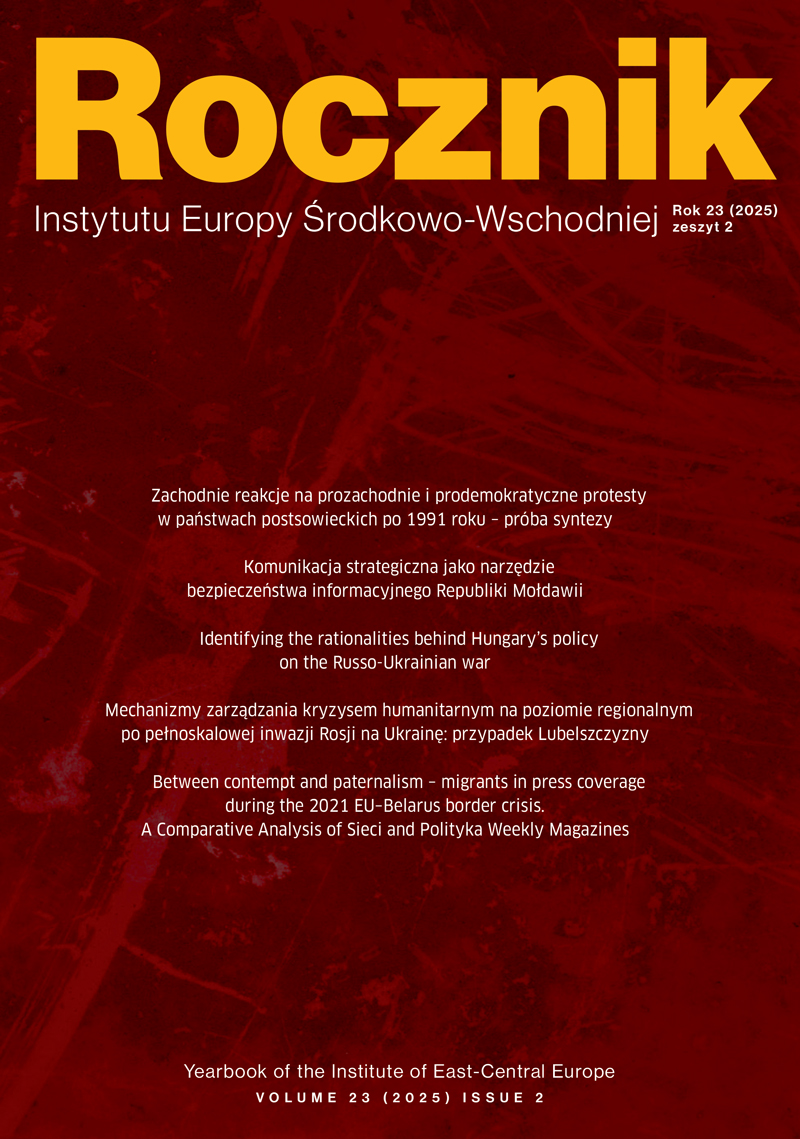
This article summarises studies on post-soviet revolutions, partially based on the author’s previous research. Additionally, it attempts to synthesise the findings in this field of study. The author aims to establish the behavioural patterns of states and international organisations in response to pro-Western and pro-democratic protests in the post-Soviet world after 1991. The main conclusion is that the Western response to protest waves and resistance to the Russian attack was largely reactive in nature. Readiness to provide political support was a result of social pressures and was most often insufficient. Additionally, only in Ukraine and Georgia did post-Soviet protests boost the enlargement and political efforts of NATO and the EU. This analysis confirms the thesis regarding the weakness of the Western response. Moreover, it confirms the falseness of the Russian propaganda narrative that protests in the East were founded by the West as part of NATO and EU enlargement efforts.
P. Kowal, Zachodnie reakcje na prozachodnie i prodemokratyczne protesty w państwach postsowieckich po 1991 roku – próba syntezy, „Rocznik Instytutu Europy Środkowo-Wschodniej” 23 (2025), z. 2, s. 7–37, DOI: https://doi.org/10.36874/RIESW.2025.2.1
The importance of strategic communication in state policy is steadily growing. This is related both to the increasing threats to state information security and the need to shape an appropriate state image and brand in the international perspective. The subject of this article is an analysis of the Republic of Moldova’s formal, legal, and institutional information security tools in the context of strategic communication. The research process utilises desk research, which analyses normative acts and strategic documents produced by Moldovan state authorities, as well as an institutional analysis covering the activities of entities responsible for implementing information security.
R. Rajczyk, Komunikacja strategiczna jako narzędzie bezpieczeństwa informacyjnego Republiki Mołdawii, „Rocznik Instytutu Europy Środkowo-Wschodniej” 23 (2025), z. 2, s. 39–59, DOI: https://doi.org/10.36874/RIESW.2025.2.2
The research objective of this article was to uncover the rationalities of Hungary’s policy towards the full-scale phase of the Russo-Ukrainian war, as well as related issues, while deliberately avoiding the common pitfalls in this field of oversimplification, politicisation, and analyses framed from a single-cause perspective. The analysis was conducted on the basis of rational choice theory, as adapted for the purposes of Foreign Policy Analysis, employing holistic causal reasoning without reference to any particular theory of international relations. It also drew upon insights derived from numerous expert seminars addressing the research problem, unstructured expert interviews, a critical review of the literature, and the analysis of primary sources. As a result of the research, several key domains influencing the formation of Hungarian foreign policy regarding the Russo-Ukrainian war were identified, namely: geopolitical and geographical preconditioning, historical experience, anticipation of shifts in the international order, policy towards the Hungarian minority in neighbouring states, energy policy, and domestic factors. These domains, however, are not isolated from one another; they frequently intersect and mutually condition one another, encompassing both objective and subjective components.
J. Bornio, B. Lux, Identifying the rationalities behind Hungary’s policy on the Russo-Ukrainian war, „Rocznik Instytutu Europy Środkowo-Wschodniej” 23 (2025), z. 2, s. 61–97,
DOI: https://doi.org/10.36874/RIESW.2025.2.3
Following Russia’s full-scale invasion of Ukraine in 2022, assistance was organised in the Lublin Voivodeship for thousands of people fleeing the country. This assistance encompassed both reception support and measures aimed at adaptation and integration. Relief efforts involved actors operating at various levels and of diverse nature. The aim of this article, grounded in the concept of multi-level governance (MLG) of migration, is to analyse the mechanisms of humanitarian (migration) crisis management in the Lublin Voivodeship after 24 February 2022, taking into account the diversity of actors, evolving needs, and modes of response. The central question posed is whether the identified crisis management mechanisms can indeed be characterised as MLG. The article outlines types of assistance activities undertaken in the region, as well as successive phases corresponding to shifting needs. It further examines modes of governance associated with different categories of actors (operating across varied degrees of formalisation, centralisation, and hierarchy). It also identifies distinct dynamics of action: institutional inertia revealing systemic gaps, ad hoc measures implemented outside the formal system, and innovative solutions emerging from their interplay that contributed to strategic governance. The analysis leads to the conclusion that, in the case of the Lublin region, there were tensions between the centralist approach and local initiatives, as well as within the initiatives themselves. The magnitude of the crisis necessitated cooperation and flexibility, making isolated action impossible and resulting in significant changes to the regional migration governance ecosystem. The study draws on qualitative empirical data from 68 individual in-depth interviews (IDIs) and 2 focus group interviews conducted with representatives of public administration, civil society organisations, the business sector, religious communities, and informal initiatives, carried out between 2022 and 2023 as part of an international research project funded under the NAWA Intervention Grants programme. These were supplemented with secondary data, including statistics and available analyses.
K. Podgórska, Mechanizmy zarządzania kryzysem humanitarnym na poziomie regionalnym po pełnoskalowej inwazji Rosji na Ukrainę: przypadek Lubelszczyzny, „Rocznik Instytutu Europy Środkowo-Wschodniej” 23 (2025), z. 2, s. 99–124, DOI: https://doi.org/10.36874/RIESW.2025.2.4
The aim of this article is to examine how metaphors of migrants, present in Polish press discourse, shape their image in terms of warmth and competence, following the assumptions of the Stereotype Content Model (SCM). The study is based on metaphor analysis grounded in Conceptual Metaphor Theory (CMT), drawing on Kövecses’s extended framework and the hierarchy of the Extended Great Chain of Being (EGCB). A comparison of texts from the weeklies “Polityka” and “Sieci”, which represent divergent ideological orientations, demonstrates that these magazines construct distinct repertoires of metaphors relating to migrants. In the left-liberal “Polityka”, metaphors that diminish migrants’ agency predominate, encouraging their categorisation as a group characterised by low competence but relatively high warmth. Conversely, in right-wing conservative “Sieci”, metaphors depicting migrants as a threat occur more frequently, lowering their perceived warmth while yielding a more varied assessment of their competence. Thus, the repertoire of metaphors is closely linked to the content of the resulting stereotype, giving rise to different forms – paternalistic in “Polityka” and contemptuous in “Sieci”.
M. Bachryj, Between contempt and paternalism – migrants in press coverage during the 2021 EU–Belarus border crisis: a comparative analysis of “Sieci” and “Polityka” weekly magazines, „Rocznik Instytutu Europy Środkowo-Wschodniej” 23 (2025), z. 2, s. 125–147, DOI: https://doi.org/10.36874/RIESW.2025.2.5
This article is an attempt at a new look at sovereignty and Polish national identity under conditions of progressing globalisation and international integration, i.e. in the current situation observed in Europe and worldwide, from the end of the Cold War to the present day.
J. M. Fischer, Suwerenność i tożsamość kulturowa Polski w dobie integracji i globalizacji. Analiza systemowa, „Rocznik Instytutu Europy Środkowo-Wschodniej” 23 (2025), z. 2, s. 149–173, DOI: https://doi.org/10.36874/RIESW.2025.2.6
The article offers a review and analytical interpretation of the book by Bartłomiej Wypartowicz and Wojciech Kozioł, Between the Bug and the Truth: Can Poland Rebuild Its Influence in the East?, published in 2024. The point of departure for the book under discussion is the question of whether Poland can and should become a significant political player in Eastern Europe, and what kind of “game” it in fact plays – or neglects to play – towards Ukraine and Belarus. The first part of the article discusses the structure of the book and its main themes: a diagnosis of Polish Eastern policy after 1989, an analysis of the internal conditions in Ukraine and Belarus, the role of history and memory politics in regional relations, and the authors’ outline of a possible future framework for cooperation between Poland and its neighbours. The second part interprets the book through the lens of the main currents in international relations theory: realism, liberalism, constructivism, and the critical/postcolonial tradition. The article concludes that the book constitutes an important contribution to the debate on Poland’s “grand strategy” towards the East and prompts reflection on Poland’s agency in a changing international order.
P. Kusiak, Gra, w którą Polska grać musi. Uwagi na marginesie książki „Między Bugiem a prawdą. Czy Polska może odbudować swoje wpływy na Wschodzie”, „Rocznik Instytutu Europy Środkowo-Wschodniej” 23 (2025), z. 2, s. 175–190, DOI: https://doi.org/10.36874/RIESW.2025.2.7
M. Marszałkowski, Wyścig dronów: ewolucja pola walki czy strategiczna rewolucja? Refleksje na kanwie monografii „The Drones Race and International Security”, „Rocznik Instytutu Europy Środkowo-Wschodniej” 23 (2025), z. 2, s. 191–198, DOI: https://doi.org/10.36874/RIESW.2025.2.8
M. Stefan, Odwieczna arena starcia mocarstw. Artykuł recenzyjny książki Hala Brandsa „Stulecie Eurazji. 100 lat konfliktów i zimnych wojen, które ukształtowały współczesny świat”,
„Rocznik Instytutu Europy Środkowo-Wschodniej” 23 (2025), z. 2, s. 199–204, DOI: https://doi.org/10.36874/RIESW.2025.2.9