
Keyword: NATO

Baltic Team

IEŚ Commentaries 1524
12 February 2026
Jakub Bornio - Baltic Team

The Impact of the Expiration of the New START Treaty on the Security of Central and Eastern Europe

On 5 February 2026, the Treaty on Measures for the Further Reduction and Limitation of Strategic Offensive Arms (New START), concluded in 2010 by the United States and Russia, expired. Although the treaty did not cover the systems used by Russia for nuclear coercion against the states of Central and Eastern Europe (CEE), its termination has global implications and therefore...

More →


Baltic Team

IEŚ Commentaries 1515
28 January 2026
Jakub Bornio - Baltic Team

The United States National Defense Strategy and the Security of Central and Eastern Europe

The United States National Defense Strategy, published by the Department of War, operationalises and further specifies the assumptions of U.S. foreign policy articulated in the National Security Strategy. The Pentagon’s vision of the international environment assumes that U.S. policy will be guided by a doctrine of “practical realism”, the prioritisation of the Indo-Pacific...

More →

Baltic Team

IEŚ Commentaries 1492
23 December 2025
Jakub Bornio - Baltic Team

The U.S. National Security Strategy and the Security of Central and Eastern Europe

The U.S. National Security Strategy, published by the administration of Donald Trump, is a fundamental document diagnosing changes in the international security environment and outlining the United States’ efforts to adapt to new geopolitical conditions. The Strategy’s assumptions are of key importance for the security of central and eastern European states, whose...

More →

Baltic Team

IEŚ Commentaries 1461
3 November 2025
Jakub Bornio - Baltic Team

The “Estonianisation” of European Foreign Policy as a Challenge to NATO Cohesion

Recent Russian provocations directed against certain members of the North Atlantic Alliance have generated yet another axis of internal division within NATO. In this context, the Alliance faces a series of challenges in the sphere of strategic communication. The principal objective of NATO member states remains the mitigation of the adverse effects of such divisions on the...

More →

Baltic Team

IEŚ Commentaries 1415
20 August 2025
Jakub Bornio - Baltic Team

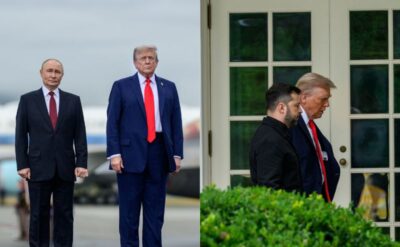
Diplomatic Manoeuvring over the Question of ‘Peace’ in Ukraine: The Trump–Putin and Trump–Zelensky Meetings

In August 2025, diplomatic efforts towards achieving a ‘peace agreement’ in Ukraine intensified. In the days following a remote meeting between European leaders and Donald Trump, a summit was held in Alaska between the US and Russian presidents. This was followed by a meeting in Washington between the US and Ukrainian presidents, with the participation of European leaders....

More →

Baltic Team

IEŚ Commentaries 1411
14 August 2025
Jakub Bornio - Baltic Team

Extraordinary Meeting of European Leaders with U.S. President Donald Trump Prior to the Russia–United States Summit in Alaska

The announcement of a meeting between the US and Russian presidents in Alaska led to a further increase in diplomatic activity among European political leaders. The series of talks with Donald Trump on 13 August 2025, organised by the German Chancellor, provided an opportunity to present the position of the so-called European Big Five and Finland on the war in Ukraine and in the...

More →

Baltic Team

IEŚ Commentaries 1236
31 October 2024
Damian Szacawa - Baltic Team

Sweden’s Security Policy: Operationalising Its Role in NATO

Upon joining NATO in March 2024, Sweden embarked on the process of integrating into the Alliance’s missions (including deterrence and defence) and embedding within NATO’s political and military structures. The centre-right coalition government led by Ulf Kristersson has significantly raised defence spending, reaching 2.14% of GDP in 2024. Over the next few years, priorities...

More →

Visegrad Team

IEŚ Commentaries 1234
31 October 2024
Jakub Bornio - Visegrad Team

NATO defence ministers meet their Indo-Pacific counterparts. Towards a global alliance?

In October 2024, the very first meeting of NATO and Indo-Pacific defence ministers took place. The event reflected the deepening practical cooperation between the partners from the two poles of Eurasia, which was intensified by Russia’s full-scale invasion of Ukraine. Despite the geographical distance between the two areas, their security systems are more interconnected...

More →

Eastern Team

IEŚ Commentaries 1134
31 May 2024
Jakub Olchowski - Eastern Team

The West’s military aid for Ukraine – crisis management in lieu of strategy

Unlocking the aid package for Ukraine by the United States will stabilize the front line and halt Russian advances, but it will not lead to a breakthrough in the war nor to Ukraine regaining the strategic initiative. Western support is scattered, unsystematic and often driven by ad hoc political considerations. Taking into account Russia’s resources and actions, aid for Ukraine...

More →

Visegrad Team

IEŚ Commentaries 1117
30 April 2024
Jakub Bornio - Visegrad Team

Nuclear deterrence on NATO’s eastern flank

Since 2014, the countries of the North Atlantic Treaty Organisation have concentrated their efforts on securing the so-called eastern flank. These efforts have thus far lacked elements of nuclear deterrence. However, the inability to effectively influence NATO has led to an increase in the use of ‘nuclear blackmail’ by Russia. Considering these circumstances, it is...

More →