The concept of the green border envisages the use of natural ecosystems as an element of a state’s security infrastructure. Its effectiveness has been demonstrated by both historical experience and the ongoing war in Ukraine, showing that wetlands, forests, and rivers can significantly constrain an adversary’s mobility, support defensive operations, and also serve as instruments of offensive warfare.
The importance of the environmental component for security. The contemporary security environment increasingly requires moving beyond a purely military perception of state borders towards an approach that recognises the natural environment as an element of national resilience and defence. The concept of the green border assumes the use of natural ecosystems – including forests, wetlands, peatlands, rivers, streams, and floodplains – as an integral component of security infrastructure. Unlike traditional fortifications, nature-based solutions combine defensive functions with climate objectives, biodiversity conservation, and enhanced socio-economic resilience. Consequently, the border is no longer perceived solely as an administrative line or military zone but rather as a multifunctional space that strengthens national security in military, environmental, and infrastructural dimensions.
This concept has gained particular importance since the beginning of Russia’s full-scale invasion of Ukraine in 2022, when wartime experience once again demonstrated the significance of natural terrain barriers in limiting military mobility and protecting critical infrastructure, while the absence of forest cover resulted in the complete exposure of the battlefield. Increasing attention is being paid to the restoration of wetlands and peatlands as a relatively low-cost yet durable component of defence strategies, particularly in countries located on NATO’s eastern flank. Naturally waterlogged or rewetted peatlands significantly impede the movement of heavy military equipment, channel potential avenues of attack, and increase the predictability of an adversary’s operations. At the same time, such measures generate benefits extending beyond the security sphere, including reduced greenhouse gas emissions, improved water retention, and support for the implementation of the EU Nature Restoration Regulation[1]. This makes natural security infrastructure an example of synergy between defence, climate, and environmental policies.
Historical experience. The use of the natural environment as part of a defence system has a long tradition. One of the best-documented European examples is the Dutch Water Defence Line, which relied on the controlled flooding of land using sluices and canals, thereby effectively restricting the mobility of enemy forces. A different model was employed during the Winter War (1939–1940), when Finland utilised the natural terrain – forests, lakes, marshes and a poorly developed road network – to channel the Red Army’s movements and employ effective ‘motti’ tactics. The importance of wetlands was also confirmed by Operation Barbarossa in 1941, when the marshes in the Pripyat Valley constituted one of the most significant natural operational obstacles in the eastern theatre of war. Paradoxically, despite an awareness of their military significance, as part of Stalin’s ‘Great Plan for the Transformation of Nature’ of 1948, the Soviet Union launched large-scale land reclamation programmes, draining approximately 800,000–1.2 million hectares[2] of peat bogs in the Ukrainian Polesie and converting them into agricultural land.
Contemporary cases – Ukraine. Ukraine’s experiences during the first months of Russia’s full-scale aggression in 2022 constitute one of the most compelling examples of the practical use of natural security infrastructure in modern warfare. The skilful utilisation of existing hydrological and topographical conditions proved to be a key element of Kyiv’s defence; Russian forces advancing from Belarus were forced to move through vast complexes of wetlands, peat bogs, and forests located in the basins of the Pripyat, Dnieper, and Irpin rivers, where the manoeuvrability of heavy equipment was severely restricted. The decision by the Ukrainian authorities to breach the dam on the Irpin River and flood the valley transformed the planned area of Russian troop concentration into a vast wetland, making manoeuvres virtually impossible[3]. Russian columns were forced to move exclusively along main roads, which increased their vulnerability to ambushes, artillery fire, and the actions of small anti-tank units. Encouraged by the example of Irpin, the Ukrainian army later blew up bridges across the vast marshes in the region bordering Belarus. As a result, natural terrain obstacles, reinforced by hydrotechnical measures, became one of the factors that prevented the invading forces from rapidly encircling and capturing Kyiv. The example of the Irpin Valley has shown that wetlands can serve as an active component of a counter-mobility system, enhancing the effectiveness of defensive operations without the need to construct extensive fortifications.
Paradoxically, despite the success of the defence of Kyiv, these experiences have not yet led to the development of a comprehensive Ukrainian strategy for utilising the natural environment to improve the security infrastructure. The current controversies stem from the competing priorities of security, economic development, and environmental protection in Ukraine. Furthermore, the idea of renaturalising river valleys is meeting with opposition from landowners, who prefer to use the land for development or agriculture, especially given that the flooding of the Irpin Valley caused extensive economic losses – many residents lost their homes and their farmland, whilst the sudden change in water conditions had a negative impact on local ecosystems and species, which were unable to adapt to the rapid flooding. Additional challenges include the pressure associated with amber mining and the need to provide local communities with alternative sources of income. This means that Ukraine’s experience highlights both the potential of natural ecosystems as an element of national defence and the limitations on implementing such solutions in the context of armed conflict and competing social and economic interests.
Water infrastructure can not only serve to strengthen a country’s defences but also become a tool for waging war. A striking example is the destruction of the Nova Kakhovka dam on the Dnieper on 6 June 2023 by Russian forces. According to the findings of the Ukrainian authorities, the blowing up of the dam was intended to cause widespread flooding and to hinder the planned Ukrainian counter-offensive by altering the terrain. This case demonstrates that hydrotechnical infrastructure can be used both as part of a defence system and as a means of conducting offensive operations, the effects of which extend beyond the military sphere to include catastrophic humanitarian and environmental consequences.
Conclusions. Historical and contemporary examples demonstrate that nature-based solutions, encompassing both natural and hydrotechnical infrastructure, can serve a dual purpose in military operations. On the one hand, wetlands, forests, rivers, and deliberately created floodplains can strengthen a state’s defensive capabilities by limiting the enemy’s mobility and supporting counter-mobility operations, as exemplified by the Netherlands, Finland, and the defence of Kyiv in 2022. On the other hand, this same infrastructure can be used as a tool for waging war, as demonstrated by the destruction of the dam at Nova Kakhovka, the consequences of which will certainly be long-term. This means that natural ecosystems and water infrastructure should be viewed not only as elements that enhance a state’s resilience but also as a strategic resource, the use of which can determine both the effectiveness of defence and the course of offensive operations.
Image: Map of wetlands in Europe
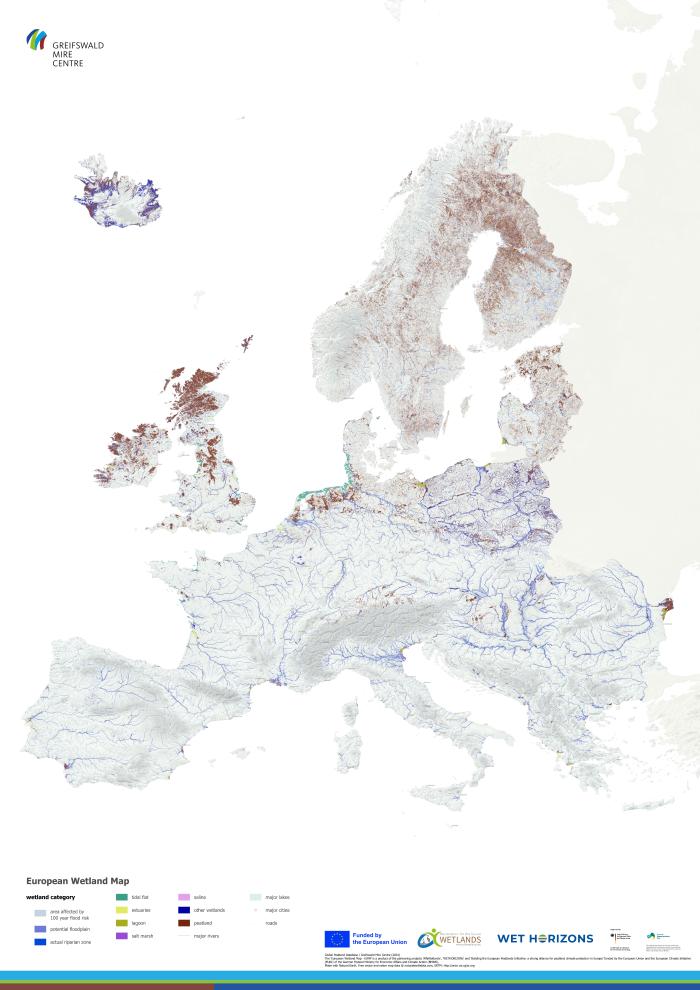
Source: European Wetland Map: Tegetmeyer, C., & Kaiser, M., Barthelmes, A. (2024). The European Wetland Map (‘EWM’), Zenodo. https://zenodo.org/records/15302184
[1] European Commission, Nature Restoration Regulation, 2024, https://environment.ec.europa.eu/topics/nature-and-biodiversity/nature-restoration-regulation_en [14.07.2026].
[2] The data in the scientific literature varies; Ukraine War Environmental Consequences Work Group, Issue 33, July 2026, https://uwecworkgroup.info/wp-content/uploads/2026/03/UWEC_Issue-33_english.pdf?utm_source=chatgpt.com [14.07.2026].
[3] O. Ivanova, I. Zotsenko, Under the Shadow of Conflict: Understanding the Belligerent Landscapes of the Kyiv Triangle, “Archaeologia Polona” 2024, nr 62, pp. 293–307, https://doi.org/10.23858/APa62.2024.3715.



Aleksandra Kuczyńska-Zonik
IEŚ Commentaries 1664 (169/2026)
Green Shield – Natural Infrastructure for Security. Part 1 – Ukraine