In recent years, the countries on NATO’s eastern flank have increasingly come to view the natural environment not only as an ecological resource but also as an element of security infrastructure. Peatlands, wetlands, and forest complexes play a particularly important role in Poland and the Baltic states, as they can support defence capabilities by limiting the mobility of a potential adversary.
Poland. Poland’s eastern and north-eastern borders run through vast forest complexes, river valleys and marshy areas of high natural value, whose defence potential remains largely untapped. Of particular significance are the Biebrza Marshes and the Narew Valley in Podlasie Province, the peat bog complex of Polesie Lubelskie, the Bug Valley, and the trees of the Białowieża, Knyszyn, and Augustów Primaeval Forests. These areas form a chain of natural terrain obstacles along the border with Russia and Belarus, and partly also with Ukraine. Their conservation and restoration could significantly enhance the resilience of the border area by limiting the number of favourable routes for troop movements and concentrating potential enemy actions on the available transport corridors (see ‘IEŚ Commentaries’, No. 1664).
The authors of the report ‘Green Shield East’[1] highlighted the potential of the natural environment for strengthening national security. With regard to forests, they recommended limiting intensive forest management, leaving deadwood in place, reducing the density and load-bearing capacity of forest roads, and utilising natural succession to increase the area of hard-to-access forest complexes. In the case of wetlands, they also emphasised the importance of removing or limiting drainage systems, raising the groundwater level, and restoring degraded peatlands, over 85% of which have previously been drained. Furthermore, they pointed out that a key element is the restoration of the natural character of river valleys through the re-establishment of meanders, increasing water retention and creating seasonal floodplains, particularly in the valleys of the Biebrza, Narew, Bug, and Wieprz rivers. In their view, such measures make it more difficult for heavy military equipment to traverse the terrain and also strengthen the ecological and hydrological resilience of border areas.
As a result of several months of cooperation between the Ministry of National Defence and the Ministry of Climate and Environment, the national ‘Eastern Shield’ programme has been expanded to include environmental components. A press release issued at the end of May 2026 stated that border areas had been classified as NO GO, SLOW GO, and GO zones, which determine the degree of troop mobility depending on environmental conditions. The NO GO zone will cover a strip approximately 5 km wide from the state border, comprising around 100,000 ha of forest, as well as extensive wetlands, peat bogs, natural floodplains and waterlogged forest complexes, which are virtually impassable areas for heavy military equipment and which can act as natural barriers restricting the enemy’s freedom of manoeuvre. The SLOW GO zone, on the other hand – a strip extending up to 50 km from the border, with a total area of approximately 700,000 ha of woodland across 48 forest districts – is to remain partially accessible and be transformed into an area with slightly higher passability through renaturation measures, such as the restoration of wetlands and peat bogs, the re-establishment of natural water regimes, increased water retention, the preservation of contiguous forest complexes, and the reduction of intensive forest management. As a result, the natural environment becomes the first line of defence. The changes proposed by the government are set to cover approximately 700 km of Poland’s eastern border, and their funding will be supported, amongst other sources, by the European FEnIKS programme, under which 450 million zlotys have been allocated for renaturation projects incorporating a defence component.
The Baltic States. Although the use of natural terrain features is a common element of the Baltic Defence Line[2] concept, implemented by Lithuania, Latvia, and Estonia, it is Lithuania that appears to be the most advanced in developing this approach at a strategic level. Unlike the other Baltic states, which focus primarily on the construction of fortification infrastructure and engineering obstacles, the Lithuanian concept is based on the comprehensive application of a counter-mobility approach, understood as an integrated system for restricting the enemy’s freedom of manoeuvre through the use of both natural and artificial obstacles. In accordance with the adopted principles, wetlands, rivers, dense forest complexes, and the terrain are not merely a backdrop for defensive operations but also an area of operational activity designed to slow down the enemy, channel the directions of attack, and enhance the effectiveness of the country’s own strike systems.
The high level of sophistication of the Lithuanian model is also evidenced by the scope of the activities undertaken. In addition to utilising existing marshlands and river valleys, Lithuania is exploring ways to use bridges and crossings for delaying actions (mining and other methods of damaging transport infrastructure), as well as deepening drainage ditches, reinforcing river crossings, and gradually expanding a multi-layered defence system comprising anti-tank barriers, minefields, fortified strongpoints, and observation systems. In 2025, it was announced that over 1.1 billion euros would be allocated to the further development of counter-mobility capabilities over a ten-year period, indicating that the natural environment has been permanently enshrined in Lithuanian defence policy as one of the pillars of the state’s deterrence and defence.
Latvia, where peatlands cover approximately 10 per cent of the country’s area and a significant proportion of historic peat extraction sites are currently undergoing restoration as part of projects funded by the European Union, also recognises the defensive value of these areas. On 29 January 2026, the Ministry of Defence officially announced that the restoration of degraded peatlands along the eastern border could constitute a significant element in strengthening the state’s defence capabilities by creating natural terrain barriers. However, the details of the plan are not available to the public.
Estonia, for its part, is one of the European countries with the highest proportion of peatlands in its land-use pattern – they cover around 20–23% of the country’s area, making it one of the world’s richest countries in terms of peatlands. At the same time, a significant proportion of these ecosystems were drained in the past for the purposes of agriculture, forestry, and peat extraction, which led to the loss of their hydrological and climatic functions. In response to these circumstances, Estonia has been consistently developing wetland restoration programmes for over two decades, funded from both national sources and European Union funds (including LIFE and Horizon Europe). The main rationale behind this policy remains climate targets, emissions reduction, and the protection of water resources, whilst the security argument plays a supplementary role. An additional challenge is pressure from the agricultural sector, which in Estonia views wetland restoration as a constraint on production capacity and a threat to livelihoods (in 2025, the Ministry of Climate temporarily suspended the implementation of one of the projects in the Kikepera nature reserve following protests by residents who feared an increased risk of flooding and the destruction of forests).
Conclusions. An analysis of the experiences of Poland and the Baltic states indicates that natural security infrastructure is becoming an increasingly important element of defence planning on NATO’s eastern flank. The restoration of forest ecosystems is not viewed solely as a measure to protect the climate and biodiversity but also as a means of enhancing counter-manoeuvrability by limiting the freedom of manoeuvre of mechanised forces, channelling the directions of attack, and protecting critical infrastructure such as roads, railway lines, and logistics facilities. At the same time, individual countries differ in the extent to which they utilise the potential of the natural environment. Estonia, thanks to numerous natural water barriers along its border with Russia, places less emphasis on creating new terrain barriers, whilst Lithuania and Latvia – which have a more open border landscape – are actively developing renaturation programmes as part of strengthening the Baltic Defence Line and the Baltic Military Mobility Area (see ‘IEŚ Commentaries’, No. 1522). Poland, for its part, is incorporating similar measures into the development of the ‘Eastern Shield’ programme, treating the restoration of ecosystems as a complement to traditional military infrastructure. These examples demonstrate that natural ecosystems are becoming not only an environmental resource but also a strategic component of modern national resilience and security, and thus of NATO’s eastern flank.
Image: Map of wetlands in Europe
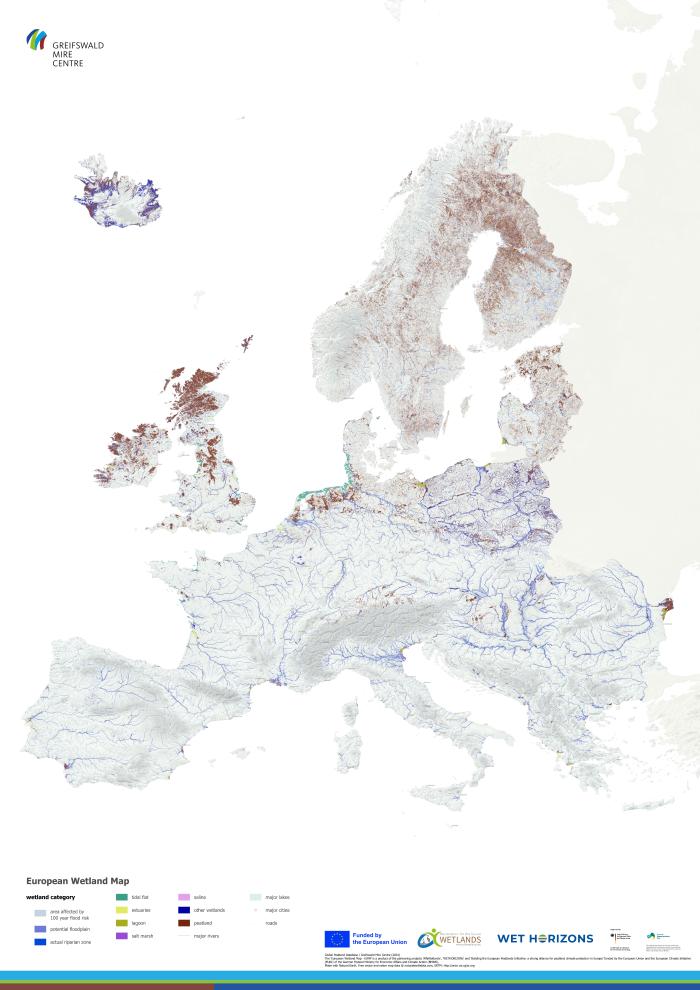
Source: European Wetland Map: Tegetmeyer, C., & Kaiser, M., Barthelmes, A. (2024). The European Wetland Map (‘EWM’), Zenodo. https://zenodo.org/records/15302184
[1] Zielona Tarcza Wschód, Warszawa 2025, https://www.clientearth.pl/media/3flcn2pd/zielona-tarcza-wschod-raport.pdf [6.07.2026].
[2] Baltic Defence Line, Kuczyńska-Zonik A. (ed.), IEŚ Policy Papers 2/2025, Instytut Europy Środkowej, https://ies.lublin.pl/ies-policy-papers/pp2025-002/ [6.07.2026].



Aleksandra Kuczyńska-Zonik
IEŚ Commentaries 1668 (173/2026)
The Green Shield – Natural Infrastructure for Security. Part 2 – Poland and the Baltic States