The examples of Finland and Romania demonstrate that natural ecosystems can serve multiple functions in security policy. In Finland, natural landscape elements have been integrated into defence planning, while in Romania, the Danube waterways can be used for military transport or to create alternative routes for exporting goods. While the potential of natural security infrastructure is increasingly recognised, its practical implementation still requires appropriate legal, institutional and social solutions.
Finland. Finland’s strategic use of its extensive forest areas and numerous lakes as a defensive asset is well-documented (“IEŚ Commentaries”, no. 1664). Key factors to consider include seasonal environmental conditions, such as snow cover, frozen lakes and rivers, and cyclical freezing and thawing of the ground. These factors influence terrain accessibility and troop mobility. Depending on the season and weather conditions, they can restrict the movement of heavy equipment by the enemy, force the use of specific routes, or increase the predictability of attack directions.
In June of this year, a working group established by the Finnish Ministry of the Environment and Ministry of Defence assessed the possibilities for coordinating activities related to ecosystem restoration and national security and identified ways to support them. The report[1] emphasised that synergies between restoration and defence can yield significant benefits. It is vital that efforts are made to restore peatlands in the regions of eastern and northern Finland, as this will have a significant impact on defence capabilities. The report indicates that these activities should be planned individually for each area, taking into account its role in the defence system. The assessment will include the impact of planned activities on the mobility of national troops, the operation of training grounds and training areas, exercise capabilities, and the maintenance of military infrastructure. One of the report’s key recommendations is the establishment of a long-term collaborative framework between the Ministry of the Environment, the Ministry of Defence, the Finnish Defence Forces, and other relevant institutions overseeing spatial and natural resource management. The working group also recommends the development of joint guidelines for restoration planning, the exchange of spatial data, and further research on the impact of peatland restoration and other ecosystems on national security. This solution is intended to enable the sustainable integration of defence considerations into restoration policy and the consideration of environmental objectives in strategic planning. This approach aligns with the concept of holistic security as part of a broader spatial management system that addresses both defensive and social, economic, and environmental needs.
A key challenge identified in the Finnish debate is the need to balance defence objectives with the interests of local communities and economic development. This problem is particularly evident in northern Finland, in the area inhabited by the indigenous Sami people. The expansion of military infrastructure and changes in spatial development may restrict traditional land use practices, particularly reindeer herding. It is important to note that both the excessive number of roads and intensive landscape intervention can have a negative impact on migration and, consequently, the functioning of local communities.
Romania. The Lower Danube floodplain and the Danube Delta represent a significant wetland system in Europe, serving as a natural reservoir, flood barrier and ecological corridor[2]. Despite the drainage and conversion of these areas into agricultural land through large-scale land improvement programmes, the delta’s proximity to Ukraine may enhance its strategic importance in the future. The primary value of the delta is not so much in its function as a barrier against land invasion (as ecosystem degradation has caused these areas to partially lose their natural barrier properties to the movement of mechanized forces), but in its location at the interface of the theatre of war, logistics infrastructure, and the NATO border. In the event of a potential NATO-Russia conflict, this region could serve as a logistical base for NATO member states’ operations, including military mobility, supplies, and humanitarian support (logistics resilience). Furthermore, the restoration of extensive wetlands and a network of canals could provide an added benefit in the form of a buffer zone, limiting the accessibility of the interior to heavy military equipment and hindering manoeuvring operations.
The geoeconomic role of this region is also significant. Following the closure of some Ukrainian Black Sea ports due to military operations, the Danube River became a key export route for Ukraine. Meanwhile, the ports of Izmail, Kiliya, and Reni, along with the Romanian port of Constanta, formed an alternative route for the export of Ukrainian agricultural products. Consequently, this area has gained importance from the perspectives of environmental protection, the security of transport infrastructure, logistical resilience, and the economic security of the Black Sea region. Concurrently, it has become more susceptible to Russian military intervention. This was confirmed by numerous Russian attacks on port infrastructure in 2023, during which there were also reports of the discovery of Russian drones on Romania’s border territory. This prompted consultations within NATO on the security of Allied borders – in relation to Article 4[3].
However, Romanian military expert Aleksandru Grumaz emphasises that leveraging the defensive assets of the natural environment requires restoring floodplains, restoring the natural dynamics of rivers, and halting illegal logging. Among the proposed solutions, he highlights the establishment of a legal framework connecting nature conservation with national security, as well as the creation – in collaboration with NATO – of ecological buffer zones along the Prut and Lower Danube rivers. In these zones, ecosystem restoration would be planned in parallel with building defensive resilience. It is important to note that this argument was previously presented in a proposal by Sam Jelliman, Brian Schmidt, and Alan Chandler as one of the pillars of the Alliance’s collective defence. However, these proposals are currently being developed by expert groups and are not part of Romania’s official security strategy[4].
Conclusions. The concept of utilising natural infrastructure for strategic purposes, known as “defensive rewilding,”[5] aims to enhance environmental resilience while bolstering national security by establishing natural barriers that impede, delay, or redirect the movement of enemy forces. This approach to the green border is most visible in Finland, but also increasingly in Poland and the Baltic states (“IEŚ Commentaries”, no. 1668), where nature is considered a strategic national resource. Therefore, the preservation of forest continuity, the maintenance of high-water levels in peat bogs and the protection of natural river valleys are permanent components of the deterrence system on NATO’s eastern flank.
In Romania, a green border could also serve logistical purposes, facilitating military mobility or – as has already happened – the export of goods from Ukraine amid Russia’s blockade of Black Sea ports. In principle, however, the importance of natural elements in the context of security remains outside the mainstream of political discussion. It should be noted that this solution is not without its limitations. The utilisation of rivers, forests, wetlands and peat bogs for defensive purposes is contingent on local geographic and hydrological conditions, as well as the season. Natural obstacles can restrict the mobility of enemy and friendly forces, complicating manoeuvring, logistics and evacuation. Furthermore, wetland restoration often conflicts with the interests of landowners, agriculture, forestry, and peat extraction, which can provoke public opposition and delay project implementation. Contemporary conflicts also demonstrate that natural barriers are not a standalone defence – they are unable to counter air attacks, missile strikes, or the use of unmanned combat systems (for more on the importance of the role of various components of military power, see “IEŚ Commentaries”, no. 1576). Therefore, green infrastructure should be regarded as a component of a multi-layered security system, working in conjunction with classic counter-mobility, reconnaissance, and strike measures.
Image: Map of wetlands in Europe
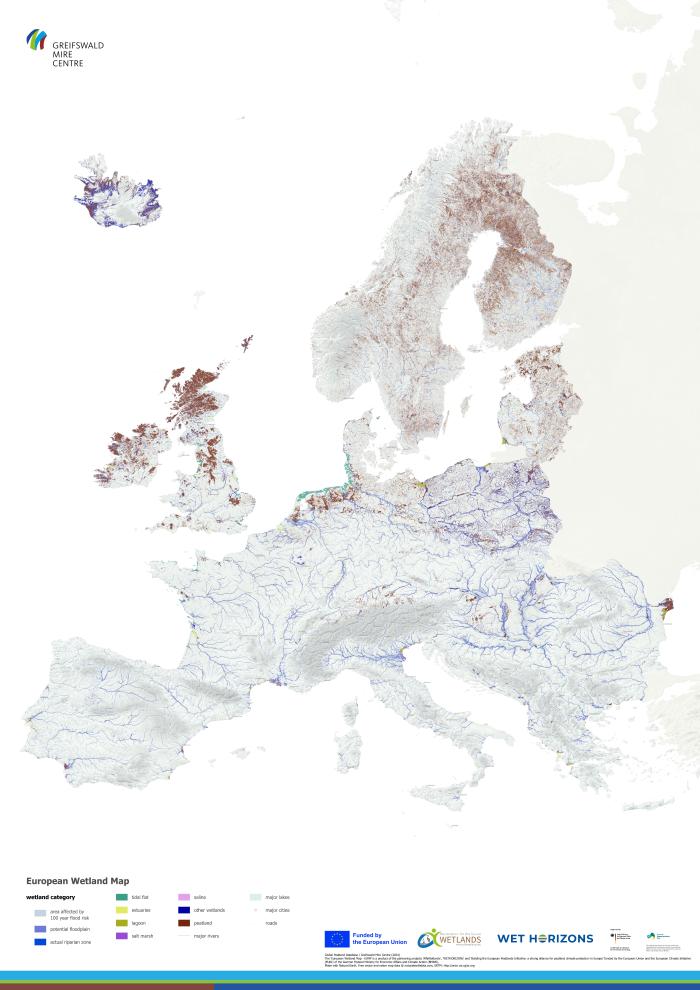
Source: European Wetland Map: Tegetmeyer, C., & Kaiser, M., Barthelmes, A. (2024). The European Wetland Map (‘EWM’), Zenodo. https://zenodo.org/records/15302184
[1] Finnish Government, Ennallistamisen ja maanpuolustukseen yhteistavoitteita määrittelevän työryhmän loppuraportti Ennallistamisen ja maanpuolustuksen yhteishyötyjä tarkasteleva työryhmä, 15 June 2026, https://julkaisut.valtioneuvosto.fi/items/f12756b3-118e-4db9-82df-aa8eab660f15 [10.07.2026].
[2] In Romania, peat bogs are of marginal spatial importance, as they occupy less than 1% of the country’s area, European Peatland Factsheet, https://europe.wetlands.org/wp-content/uploads/sites/6/2025/07/Romania.pdf?utm_source=chatgpt.com [16.07.2026].
[3] Ukraine War Analytics, Danube Ports Expansion: Izmail and Reni as Ukraine’s Alternative Export Gateway, 19 February 2026, https://ukraine-war-analytics.com/regions/danube-ports-expansion.html [24.07.2026].
[4] A. Grumaz, Natura, scut de apărare împotriva unităților de blindate inamice. Alternativă parțială pentru țările NATO din Europa, 10 May 2026, https://www.qmagazine.ro/natura-scut-de-aparare-impotriva-unitatilor-de-blindate-inamice-alternativa-partiala-pentru-tarile-nato-din-europa/ [24.07.2026].
[5] S. Jelliman, B. Schmidt, A. Chandler, Defensive Rewilding: A Nature-Based Solution for National Security, „The RUSI Journal” 2026, no. 171(3), 76-87, https://doi.org/10.1080/03071847.2026.2646067 https://www.tandfonline.com/doi/epdf/10.1080/03071847.2026.2646067?needAccess=true.



Aleksandra Kuczyńska-Zonik
IEŚ Commentaries 1672 (177/2026)
Green Shield – Natural Infrastructure for Security. Part 3 – Finland and Romania